
Choosing how to brand a polo shirt sounds simple until you have 50 shirts to order and no room for a bad call. The decoration method changes how the shirt looks, feels, wears, and helps achieve a professional look.
For corporate buyers, the best answer depends on your logo, the fabric, the budget, the order size, and how the shirts will be used. This decision is critical for creating high-quality corporate uniforms. If you’re weighing embroidery vs printing polo shirts, this is the practical way to decide without wasting money.
Key Takeaways
- Embroidery suits professional corporate uniforms: Choose it for small, simple left chest logos on piqué cotton polos, daily wear, and a polished, durable look that lasts through washes.
- Printing excels for bold, detailed designs: Ideal for colorful, complex artwork, large bulk orders, events, and promo shirts on smoother or lighter fabrics where cost and detail matter more than longevity.
- Match method to your needs: Factor in logo size/complexity, fabric type, budget/order size, and usage (daily vs short-term) to avoid bad decisions—no universal winner.
- Durability favors embroidery: Stitched logos resist fading and cracking better for frequent use, while printing works if shirts are temporary or budgets are tight.
Not Sure Whether to Choose Embroidery or Printing?
Send us your polo shirt design, logo file, quantity and preferred fabric. Our team can recommend the most suitable method for your corporate uniform order.
WhatsApp Us for RecommendationWhat embroidery and printing actually look like on polo shirts
Embroidery uses thread stitched into the shirt. Screen printing puts color on the surface of the fabric. That one difference changes almost everything, from texture to durability to apparel branding and how formal the shirt feels.
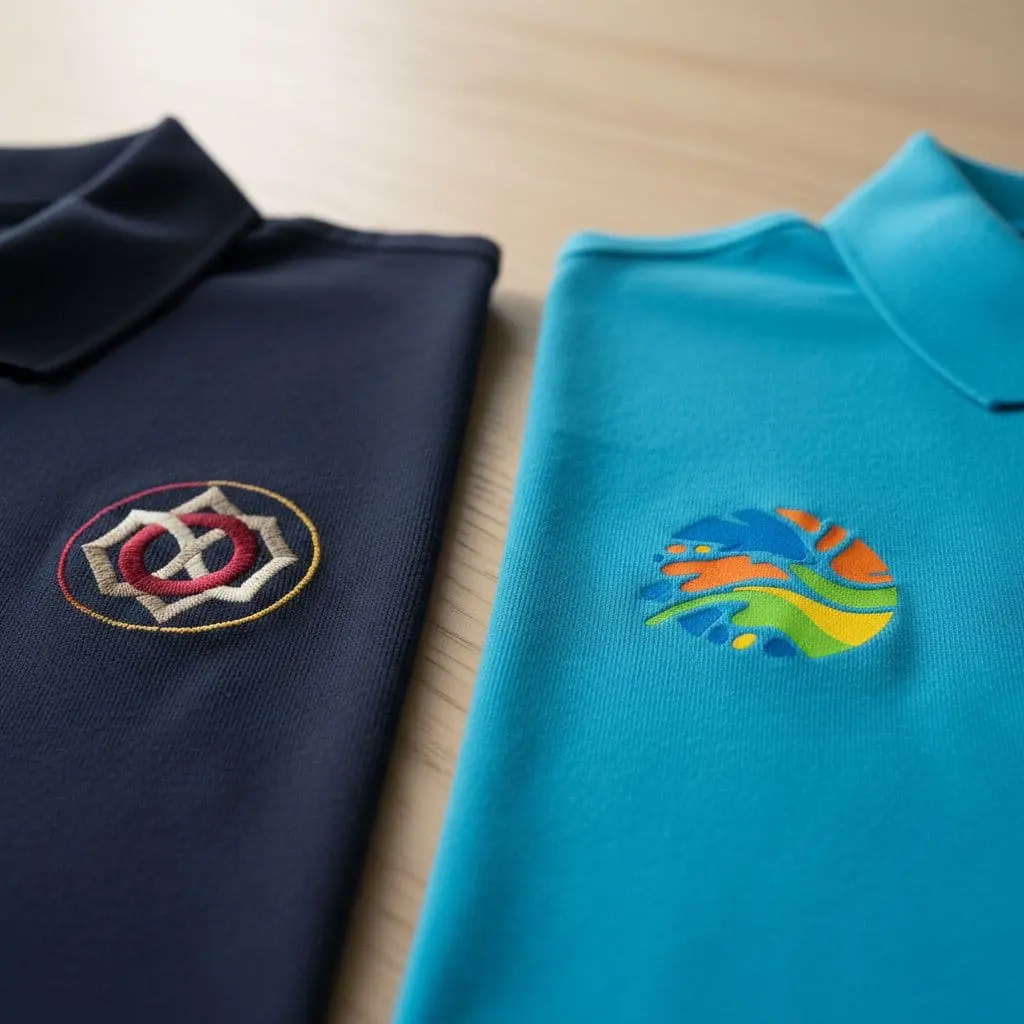
Here’s the quick side-by-side:
| Method | What you see | What it feels like | Best visual fit |
|---|---|---|---|
| Embroidery | Raised texture logo with visible thread | Textured, thicker, more structured | Office uniforms, client-facing teams, formal branding |
| Printing | Flat graphic from screen printing on the fabric surface | Smooth, lighter, less textured | Events, promotional items, bold artwork, colorful logos |
If you want the logo to look stitched in and permanent, embroidery is the obvious choice. If you want color, detail, and a flatter finish, screen printing usually makes more sense.
There isn’t a universal winner here. A polo for a bank’s front-desk team has different needs from a polo for a weekend expo crew. The shirt tells people what kind of brand they’re looking at before anyone says a word.
Why embroidery feels more polished and premium
Embroidery has presence. You can see the thread colors, feel the texture, and spot the custom logo from an angle because it sits above the fabric.
That matters on a polo shirt. Polos already sit in the middle ground between formal and casual. A stitched custom logo boosts perceived quality, pushing them toward “professional uniform” instead of “promo giveaway.”
This is why embroidered polos are common for sales teams, front-desk staff, healthcare groups, schools, and management uniforms. A small chest logo looks neat, deliberate, and expensive, even when the shirt itself is fairly standard.
Why printing can work well for bold and colorful designs
Screen printing is flatter, but that isn’t a weakness. Sometimes flat is exactly what you want. It uses a mesh screen to apply ink directly, which handles complex designs better than embroidery’s thread colors.
If your logo uses several colors, thin outlines, soft shading, or tiny details, screen printing keeps that artwork closer to the original file. Embroidery can simplify those details or make them look crowded.
Printed polos also work when the shirt is part of a campaign, launch, roadshow, or event team kit. You get more design freedom, and the result can feel modern, bright, and easy to spot across a room.
Which option works best for your logo design
Start with the logo, not the shirt. That’s the step buyers skip, and it’s where bad decisions start. A nice polo won’t save artwork that doesn’t suit the decoration method.
Ask three simple questions. Is the logo small or large? Is it clean or detailed? Does it use one or two colors, or many? Those answers usually point you in the right direction faster than any sales pitch.
Size matters too. A left chest logo and a large back graphic don’t behave the same way. Small branding often looks best stitched. Larger artwork usually gives printing more room to do its job cleanly.
Choose embroidery for small, simple logos
Embroidery is usually best for a left chest logo with a company name, symbol, initials, or short line of text, especially after digitizing prepares the design for stitching. Clean shapes stitch well with a low stitch count and proper stitch density. Simple logos hold their edges. The shirt looks tidy instead of busy.
For a more modern look with raised texture, try 3D puff embroidery. Think of law firms, property agencies, clinics, schools, hotel teams, or corporate staff. Most don’t need a photo-style graphic on a polo. They need a mark that looks sharp at a glance, just like a classic left chest logo.
If your logo can be recognized in one second, embroidery probably suits it. If people need to lean in to read it, you’re forcing thread to do a printer’s job.
Choose printing when your logo has tiny text, gradients, or many colors
Printing handles detail better. Tiny lettering, thin lines, color gradients, and multi-color artwork stay cleaner when they’re printed onto the shirt surface. Custom logos with many thread colors work better with printing methods.
This is common with event branding, sponsor logos, campaign art, product launches, and marketing teams that need the shirt to match other printed materials. A flat print can also look better when the logo is larger than a chest badge.
If the design looks crowded on a business card, it probably won’t improve once it’s stitched onto a polo.
How fabric type changes the result
Not all polos behave the same way. Fabric changes how the logo sits, how comfortable the shirt feels, and how well the decoration survives regular washing.
A structured piqué cotton polo gives you a different result than a lightweight performance fabric polo. That’s why the embroidery versus printing choice isn’t only about the logo. The base shirt matters too.
Fabric texture also changes the final look. A coarse piqué knit can soften the crisp edge of a print, while a smooth performance knit can make screen printing look cleaner. Embroidery is often more forgiving on textured polos because the thread adds definition.
Best fabrics for embroidery on polo shirts
Embroidery works best on higher fabric weight, more stable fabrics. Traditional piqué cotton polos, heavier cotton blends, and structured work polos usually hold stitching well. These fabrics offer great durability and can support the thread without puckering as easily, and the raised logo looks like part of the garment. That’s one reason embroidered polos feel so natural in office uniforms and daily workwear.
For standard corporate polos, embroidery is often the safer bet. The shirt keeps its shape, the chest area stays neat, and the logo doesn’t feel like an afterthought.
Best fabrics for printing on polo shirts
Printing often suits smoother fabrics and lighter blends. Many performance polos, poly-cotton blends, and softer surface finishes take prints nicely because the logo can sit flat and clean.
This can be helpful for sports-style staff polos, event uniforms, retail activations, and teams working in hot environments. A printed logo usually feels lighter than dense stitching, which matters on lightweight shirts.
Some stretchy or thin polos don’t look their best with heavy embroidery. The fabric can pull, the logo can feel bulky, and the drape of the shirt can change. In those cases, printing is usually the cleaner option.
How budget and order size affect the final cost
Money changes the answer fast. A decoration method that looks better on paper may not fit the order once quantities, setup costs, and replacement cycles are added in.
Embroidery usually costs more per shirt due to higher setup costs from digitizing. Screen printing often gets cheaper as volume goes up and becomes cost-effective for large bulk orders, thanks to a lower minimum order quantity requirement for some simple print runs. But price alone can fool you, especially if the polos are meant to last and you factor in the long-term durability of the garment.
Reorders matter too. If you’re buying uniforms every quarter, a method that lasts longer can reduce replacement costs. If you’re buying one big batch for a short campaign, the lower unit price of printing can be the smarter move.
When embroidery is the smarter value for smaller orders
For smaller staff orders, embroidery can be worth the higher unit cost. The shirt looks more polished, the branding feels permanent, and the logo usually holds up through repeated wear and washing.
That makes sense for long-term uniforms. If you’re outfitting 10, 20, or 40 people who will wear the shirts every week, paying more upfront can save you from replacing tired-looking polos too soon.
HR teams, clinics, schools, and smaller offices often land here. They don’t need the cheapest shirt. They need the one that still looks presentable months later.
When printing saves money on larger runs
Printing often wins on large runs, especially for event shirts, promotions, roadshows, seasonal staff, or short-term campaigns. Once quantity goes up, the cost per shirt can drop enough to change the whole budget.
That’s useful for conferences, F&B pop-ups, retail launches, and student events where appearance matters, but long-term wear doesn’t. A printed polo can look great on day one and still make financial sense when you need a lot of them fast.
If you’re buying 200 shirts for a three-day event, embroidery may be overkill. If you’re buying 25 polos for your reception team, printing may be the false economy.
Think about how often the polo shirts will be worn
This is where many buyers get their answer. Is the polo a uniform, or is it a costume for one moment? Those are two different jobs.
A shirt worn every Monday through Friday needs a different decoration choice than a shirt worn at a product launch, school open day, or trade booth. Use case beats theory.
This is especially true for schools, retail teams, F&B staff, and customer-service roles. The shirt isn’t only branded clothing. It’s part of daily presentation. That changes what “good value” looks like.
Daily uniforms usually benefit from embroidery
For daily wear in corporate uniforms, embroidery is usually the better fit. It resists fading, doesn’t crack, and keeps its shape after high wash frequency better than most printed finishes. This durability directly ties to usage, ensuring long-term apparel branding stays sharp.
That matters in retail, hospitality, healthcare, property, education, and office teams that see customers face to face. A worn-out logo sends the wrong message, even if the shirt itself is still fine.
When the polo is part of your brand every week, embroidery pays you back in appearance and lifespan.
Event and promo polos can be a better fit for printing
For temporary use, printing is often the smarter call. You can keep more design detail, control cost, and handle bulk orders with a lower minimum order quantity without turning short-term promotional items into a long-term expense.
This is why printed polos show up at launches, internal campaigns, expo booths, volunteer teams, sports days, and staff appreciation events. They don’t need to survive years of industrial laundry or match the durability of daily wear. They need to look good at the right moment.
Printing also gives you more room for creative artwork. If the shirt is part of a theme, slogan, or one-off promotion, flat graphics usually carry that better than stitching.
Durability, wash life, and brand image side by side
Branding isn’t only about what the shirt looks like when it comes out of the box. It’s about month three, month six, and after plenty of wash cycles. That’s where the difference between embroidery and printing on corporate polos becomes hard to ignore.
The choice also shapes brand image and perceived quality. Embroidery often reads as formal, steady, and established. Printing feels more flexible, more visual, and sometimes more promotional. Both can work, but they don’t say the same thing.
For buyers, that matters as much as lifespan. A finance team, private school, or hotel may want polish and permanence. A roadshow crew or festival partner may want visibility, color, and cost control.
Why embroidery usually lasts longer
Embroidery holds up well because the logo is stitched into the fabric rather than sitting on top of it, thanks to its high stitch density. Thread doesn’t peel. It doesn’t crack. It usually keeps its color and structure through heavy rotation.
For uniforms, that is a big deal. Staff shirts get washed often, stuffed into lockers, worn in the sun, and pulled on in a hurry. Embroidery handles that kind of routine better than most printed options.
If your priority is durability and a strong professional image, embroidery is the safe answer.
When printing still makes sense despite lower durability
Printing still has a place, whether through screen printing, DTF printing, DTG printing, sublimation, or heat transfer. If the shirt is short-term, the artwork is complex, or the budget is tight, printing can be the right business decision. While ink adhesion can lead to cracking over time, especially with frequent washes, not every polo needs to survive years of wear.
Some only need to do one job well, support a campaign, identify a team, or match a colorful brand system that embroidery can’t reproduce cleanly.
So yes, embroidery usually lasts longer. But the best option is still the one that fits the purpose, not the one with the longest life on paper.
Frequently Asked Questions
When should I choose embroidery for polo shirts?
Embroidery is best for small, simple logos like left chest designs on structured piqué cotton polos used in daily corporate uniforms. It provides a premium, textured look with superior durability through washes and wear. Opt for it when you need a professional image for office, sales, or client-facing teams.
When is screen printing the better option?
Choose printing for complex, colorful logos with gradients, tiny details, or multiple colors on larger artwork or bulk event orders. It keeps designs flat and vibrant on smoother fabrics, saving money on high volumes for promotions, roadshows, or short-term campaigns. It’s ideal when detail and cost beat long-term wear.
Does fabric type matter in embroidery vs printing?
Yes, embroidery works best on heavier, stable fabrics like piqué cotton that hold stitches without puckering, enhancing the professional uniform feel. Printing suits lighter, smoother performance blends where flat ink sits cleanly without bulk. Textured fabrics forgive embroidery more, while smooth ones sharpen prints.
How do budget and order size affect the choice?
Embroidery has higher setup costs but offers better value for smaller orders (10-50 shirts) needing longevity in uniforms. Printing drops in price per shirt for large runs (200+), making it smarter for events or promos. Factor in reorders and wash life—durability can offset upfront costs.
Is embroidery more durable than printing on polos?
Embroidery usually lasts longer since thread is stitched into the fabric, resisting cracks, fades, and heavy washing in daily use. Printing can crack over time with frequent laundry but suffices for short-term shirts. For corporate teams wearing polos weekly, embroidery maintains brand image better.
The best choice is the one that fits the job
If you want a cleaner, more professional look for corporate uniforms and longer-lasting polos, choose embroidery. It suits left chest logos, piqué cotton fabrics, daily wear, and brands that want polish.
If you need more detail, more color, lower pricing for bulk orders, or shirts for short-term use, choose printing. It suits larger runs, complex artwork, lighter fabrics, and event-driven orders.
In the embroidery vs printing polo shirts decision, match the method to custom logos, fabric, budget, quantity, and usage. Here’s your final checklist to get it right: consider custom logos and left chest logo placement first, then piqué cotton or other fabrics, budget next, bulk orders volume, and how the shirts fit corporate uniforms for that lasting professional look. Nail those five, and the polos will look sharp on day one and keep paying off long after.
Ready to Order Corporate Polo Shirts?
JS Uniform can help you choose the right polo shirt fabric, logo placement, embroidery or printing method based on your design, quantity and budget.
Request a Quote WhatsApp Now