
The right T-shirt design size depends on three things: where the print sits, how big the shirt is and which printing method you use.
A left chest logo usually measures 7.5 to 10 cm (3 to 4 in) wide, while a full front print on an adult M typically runs 25 to 30 cm (10 to 12 in) wide.
Get these numbers wrong and the logo looks lost on a 3XL or cramped on a size S, usually after the whole batch is printed.
Recommended T Shirt Design Size for Different Print Positions
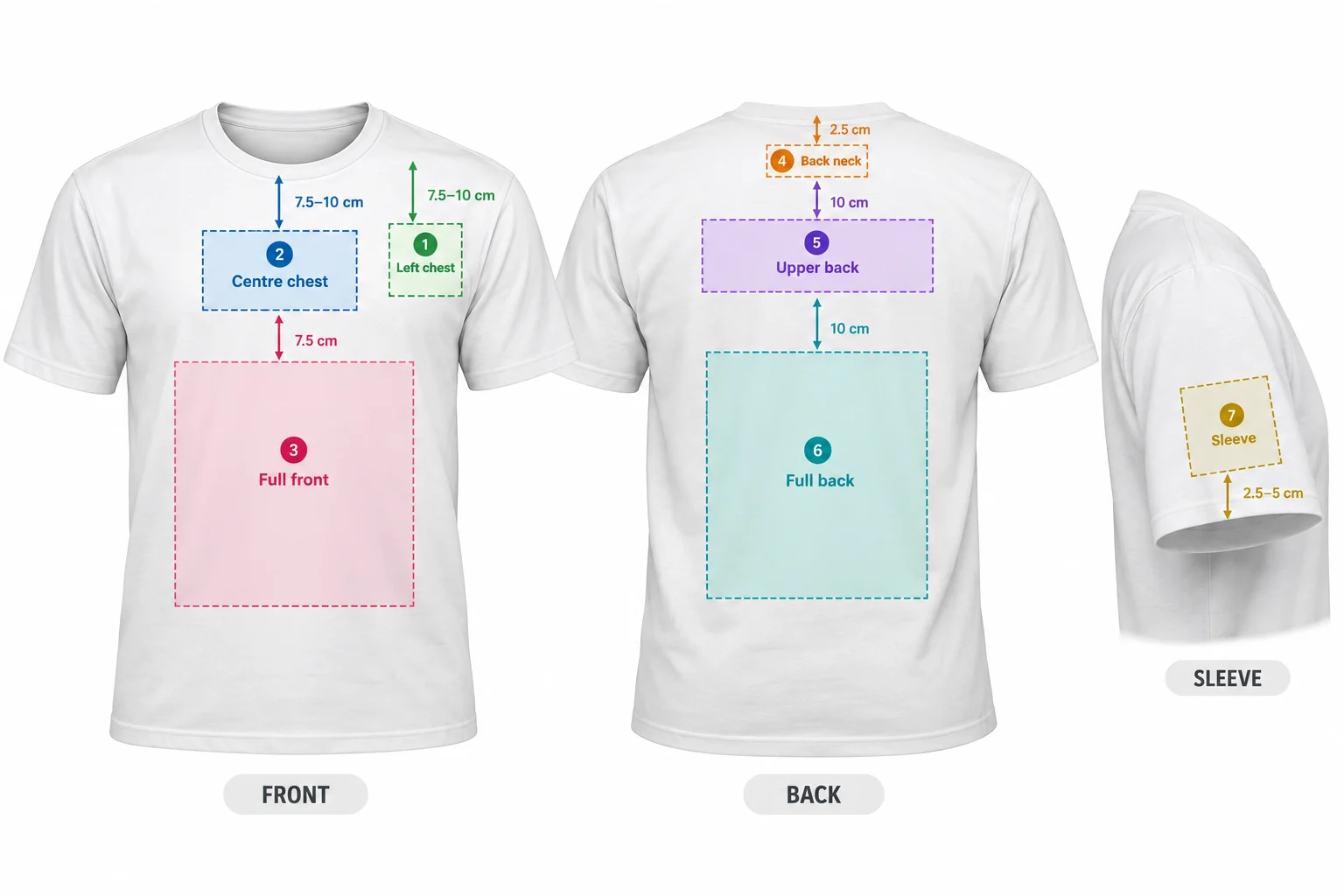
Each print position has a comfortable size range that keeps the design readable at normal viewing distance.
The figures below assume an adult size M shirt laid flat, with every distance measured from the base of the collar seam down to the top edge of the design.
| Placement | Width | Max height | Below collar | Common use |
|---|---|---|---|---|
| Left chest | 7.5 to 10 cm (3 to 4 in) | 7.5 to 10 cm (3 to 4 in) | 7.5 to 10 cm (3 to 4 in) | Staff uniforms, polos |
| Centre chest | 15 to 25 cm (6 to 10 in) | 10 to 15 cm (4 to 6 in) | 7.5 to 10 cm (3 to 4 in) | Event tees, slogans |
| Full front | 25 to 30 cm (10 to 12 in) | 30 to 35 cm (12 to 14 in) | 7.5 cm (3 in) | Campaign and merchandise shirts |
| Back neck | 5 to 7.5 cm (2 to 3 in) | 5 to 7.5 cm (2 to 3 in) | 2.5 cm (1 in) | Small logo, website, tagline |
| Upper back | 25 to 35 cm (10 to 14 in) | 5 to 10 cm (2 to 4 in) | 10 cm (4 in) | Company name, staff names |
| Full back | 25 to 35 cm (10 to 14 in) | 35 to 38 cm (14 to 15 in) | 10 cm (4 in) | Sponsor lists, event artwork |
| Sleeve | 5 to 9 cm (2 to 3.5 in) | 5 to 9 cm (2 to 3.5 in) | 2.5 to 5 cm (1 to 2 in) above sleeve hem | Secondary logo, flags |
Treat these ranges as starting points. Final positions should always be checked on an artwork proof, since collar depth and shoulder width differ between round neck tees, oversized cuts and polos.
Request a free quotation from JS Uniform with your preferred design size and placement, and the team will confirm what works on your chosen garment.
How to Measure Your Shirt Before Picking a Print Size
Letter sizes are not a reliable reference, because an M from one garment range can be several centimetres narrower than an M from another.
Measure the shirt you will actually print on, ideally a sample from our JS Uniform catalogue.
Step 1: Lay the T-Shirt Flat
Place the T-shirt on a flat surface and smooth out any wrinkles to ensure accurate measurements.
Step 2: Measure the Chest Width
Measure straight across the shirt, approximately 2.5 cm (1 inch) below the armpits.
Step 3: Check the Printable Length
Measure the available printing area, starting below the collar seam and ending approximately 10 cm above the bottom hem.
Step 4: Calculate the Ideal Print Size
Keep your full front design around 50–60% of the shirt’s chest width. For example, a T-shirt measuring 50 cm across suits a print width of 25–30 cm.
Write these measurements down per size. They become the reference for your proof and your quotation.
Scaling One Design Across a Mixed Size Run
Bulk orders rarely arrive in one size, so the artwork has to look balanced from the smallest shirt to the largest. Most teams choose between two approaches.
| Approach | How it works | Best for | Watch-out |
|---|---|---|---|
| One print size | Artwork sized to fit the smallest shirt in the order | Narrow size runs, tight budgets | Print looks small on 2XL and 3XL |
| Two print sizes | One artwork for S to M, a larger one for L and above | Wide size runs, visible branding | Silk screen may need an extra screen |
The second option adds a little setup with silk screen printing, which can shift the unit cost.
Our T-shirt printing price guide explains how screens and colours affect pricing for custom-made corporate shirts and corporate polo shirts.
How the Printing Method Changes Your Size Limits
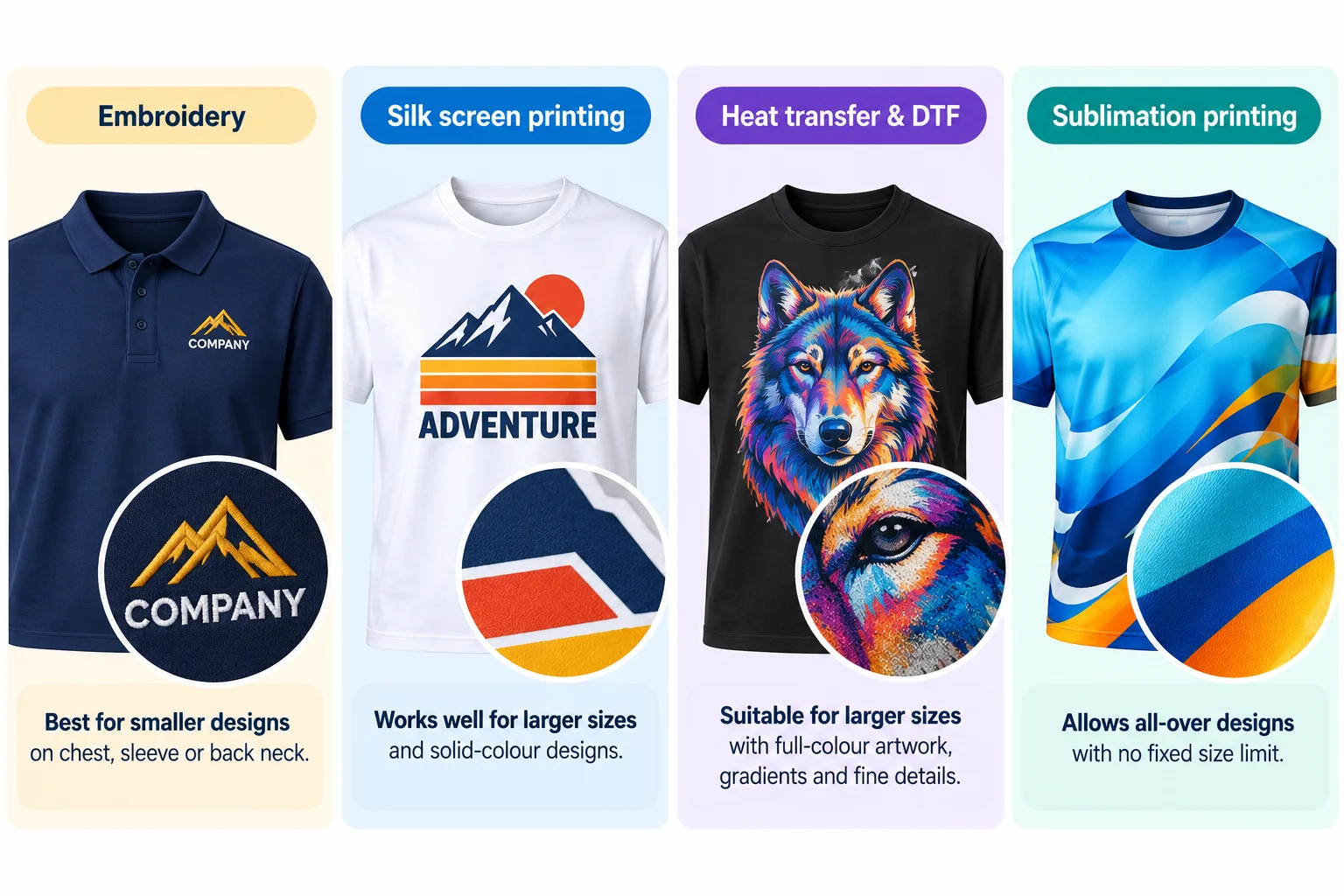
The same logo can need a different size depending on how it is applied. Check these limits before finalising your measurements.
• Embroidery suits compact logos on the left chest, sleeve or back neck. Large stitched areas add weight and stiffness to a T-shirt.
• Silk screen printing handles solid-colour designs well at chest and back sizes, and works efficiently for larger batches.
• Heat transfer printing and DTF printing shirts reproduce full-colour artwork with gradients and fine text at centre chest or full back sizes.
• Sublimation printing colours polyester fabric edge to edge, so all-over designs are not bound by the chart above.
Prepare Artwork at the Actual Print Size
Artwork should be created at the size it will be printed.
Raster images (JPG, PNG) need 300 pixels per inch at final size, so a 28 cm (11 in) full front print needs roughly 3,300 pixels across.
Vector files scale cleanly to any placement in the chart. JS Uniform’s website lists .ai or .pdf files up to 5MB as the preferred format for submissions.
Fine lines and very small text may fill in with some methods, and the proof stage flags these early.
Send your artwork and size breakdown on WhatsApp for a free quotation and a print size recommendation.
Get Accurate Print Sizing with JS Uniform
JS Uniform’s custom T-shirt printing in KL helps businesses avoid incorrect logo sizes, uneven placements and costly reprints. Every order goes through artwork review, garment selection and mock-up approval before production.
- Fewer reprints: Print dimensions and placements are checked across different garment sizes before bulk production.
- Printing methods that suit your design: Silk screen, heat transfer, DTF, embroidery and sublimation are matched to your artwork, fabric and quantity.
- Apparel options for every team: Choose custom-made corporate uniforms, corporate polo shirts, custom bomber jackets or custom oversized T-shirts to suit your branding needs.
- Consistent repeat orders: In-house production in Ampang helps maintain approved specifications across future batches.
JS Uniform has produced custom apparel since 1985, is a member of the Malaysia Knitting Manufacturers Association (MKMA) and the Malaysia Gifts & Premium Association (MGPA), and delivers nationwide.
Request Your Custom T-Shirt Printing Quote Today
Avoid oversized logos, awkward placements and costly reprints on your bulk T-shirt orders.
Let JS Uniform help you finalise the ideal T shirt design size, printing method and placement for every garment size before production begins.
Request your free T-shirt printing quotation from JS Uniform today. Share your artwork, quantity and size breakdown to receive a customised printing recommendation for your team.
Frequently Asked Questions About T-Shirt Design Size
A full front print on an adult M usually measures 25 to 30 cm (10 to 12 in) wide, and JS Uniform confirms the exact width on your artwork proof before printing.
A left chest logo works best at 7.5 to 10 cm (3 to 4 in) wide, a compact size that suits both embroidery and silk screen printing at JS Uniform.
One size works if the print is set to fit the smallest shirt, though JS Uniform can prepare a second, larger artwork for L and above when the order covers a wide size spread.
Most front prints start 7.5 to 10 cm (3 to 4 in) below the collar seam, and JS Uniform shows this distance on the proof so you can adjust it before production.
JS Uniform prefers vector .ai or .pdf files up to 5MB, which scale cleanly to any chest, back or sleeve print size.
Yes, sublimation on polyester can cover the entire shirt, while embroidery at JS Uniform’s Ampang facility suits compact logos rather than large chest or back artwork.